

Medicare covers it on a person. Robot makers buy it for machines.
Psyonic sells one bionic hand. In the US, insurers including Medicare have covered it for people who lost a hand.
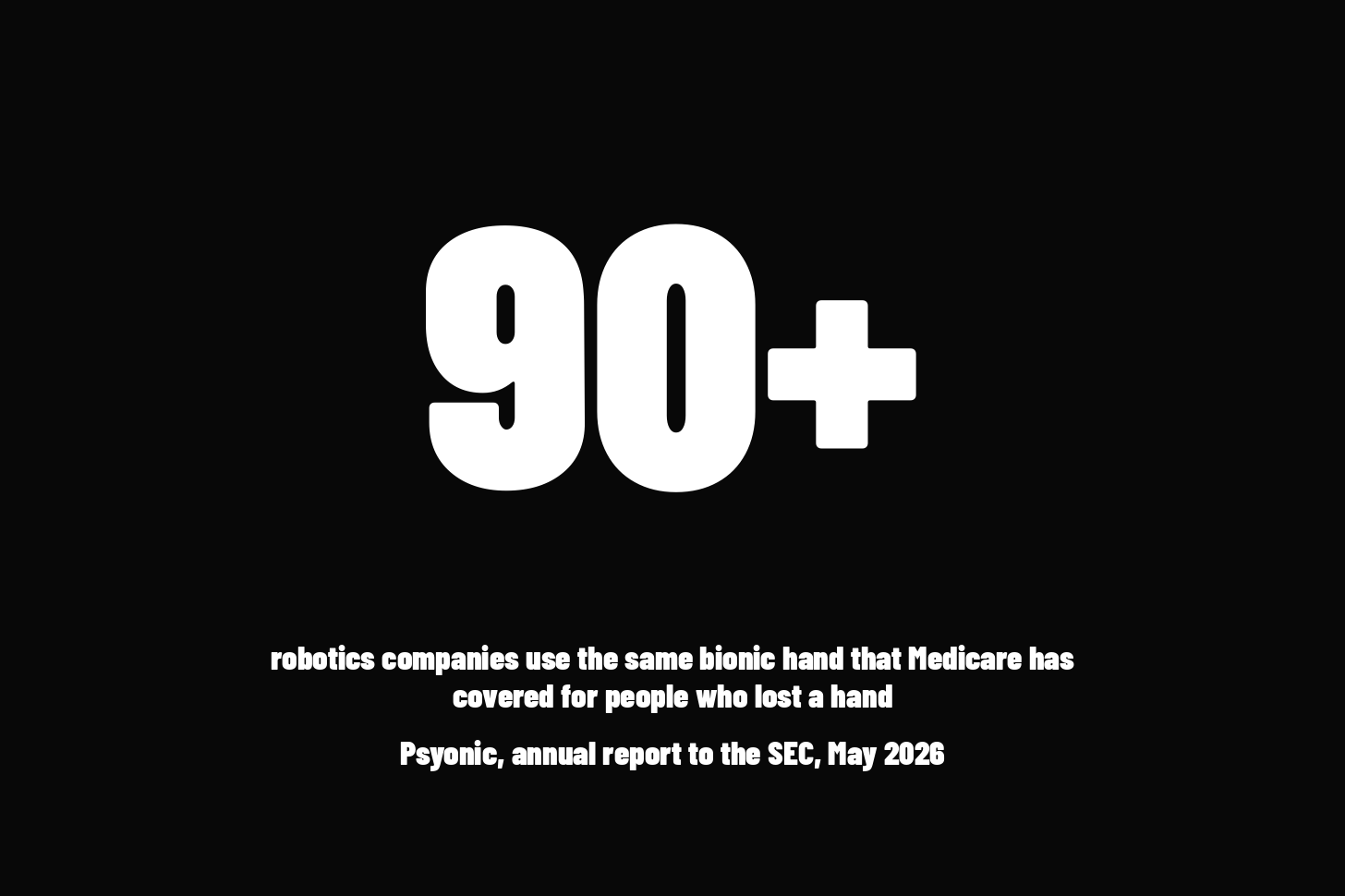
More than 90 robotics companies use the same hand on machines.
The Signal
Touch is the data robots lack. A robot that picks up a thin cup or seats a plug needs to feel contact, and today most of that data comes from a person steering a robot remotely. It is slow and it needs expensive hardware.
Psyonic is a small company in San Diego with one product. The Ability Hand is a bionic hand with touch sensors in the fingers.
On September 30, Semafor reported a plan. Aadeel Akhtar, the CEO, said Psyonic is in the early stages of a plan to deploy thousands of hands, with a focus on Pakistan, and to pay the people who wear them. The hand logs the forces, torques and finger positions of every grip. Synced with video from a camera the wearer carries, that becomes training data for robot hands. Akhtar said what Psyonic plans to sell is the robot models trained on that data. The plan has no published dates and no published rates.
I don’t know what a fair price is for the way a person closes a hand.
Both markets already exist. Psyonic’s annual report to the SEC, dated May 15, says the hand has been covered by insurers including Medicare, the VA and workers’ compensation. The company says it designed the hand from the start so Medicare would pay for it.
The same report says more than 90 robotics companies use the hand, Toyota, Mercedes, Hexagon and Amazon among them. Net revenue for 2025 was $5.35 million, about 60% more than in 2024. Psyonic credits both markets and does not split them. The report also shows a $1.2 million loss and a going-concern note.
The second company is Wandercraft. On August 11 the FDA cleared Eve for home use by adults with spinal cord injuries. Eve is a motorized frame worn over the legs that keeps its own balance, so the person standing in it has both hands free. Wandercraft’s CEO describes Eve’s use in plain terms: making coffee at the kitchen counter. Eve exists for moments like that one.
Eve needs a prescription and a companion trained in five two-hour sessions. Wandercraft launched it in the US on September 17.
Medicare already has a payment code for personal exoskeletons, in use since 2024. That year’s fee schedule put the one-time payment between $81,929 and $109,238. In August, Wandercraft said it expected Eve to qualify within 60 to 90 days of clearance. That window closes in early November.
On October 1 Wandercraft bought Ekso Bionics, whose Indego Personal exoskeleton is billed under the same code. Wandercraft describes itself as one software platform for machines that move, with medical and industrial uses. Its catalog includes Calvin-40, a humanoid built for heavy lifting in factories. HLTH reported that Wandercraft uses sensor and movement data to improve its balance algorithms, and applies similar technology to the humanoid.
Put the two companies side by side. The health system pays for a machine that sits on a person’s body. The machine is full of sensors that measure how that body grips or balances. The company that makes it also builds machines that work with no person inside.
The payment rules I read classify these devices as a brace or a prosthesis. None of the documents I read for this edition says who owns what the device records. Psyonic’s plan proposes paying the wearer. It has not said how much.
In the US, the person wearing a Psyonic hand is a Medicare patient. In Psyonic’s plan for Pakistan, the person wearing the same hand would be paid as a source.
The Application
The warehouse floor as a training set. Ultra, a Brooklyn company, rents packing robots to warehouses by the month. On October 9 it announced a $50 million Series A led by Framework Ventures, and it says its robots have packed more than 500,000 orders. The software that controls the arms comes from Physical Intelligence. In a February post, Physical Intelligence reported that adding Ultra’s own data to the model’s training raised packing throughput. The same post shows the model at work for Weave, a laundry-folding robot company. The customer’s daily work improves a model its supplier also sells to others.
Touch from a glove. A Stanford team posted SoTa this month, a soft sensor skin that costs under $10 in materials. It covers the whole hand with the same 202-point layout on a person and on a robot. In three lab tasks, adding 150 human demonstrations per task to a fixed set of robot demonstrations raised average success from 22.8% to 45.9%. Each condition ran 40 trials with one training seed. The human data only fed a side task: recognizing which phase of the job the robot was in. The movements came from robot data alone. The largest gains came on objects the robot had never seen. It is a preprint, not yet peer reviewed.
The people around the machine. Eve’s clearance comes with a care pathway: a clinical assessment, an individual fitting and five two-hour training sessions for the user and a companion. Distribution runs through National Seating & Mobility, with more than 180 locations in the US and Canada, plus rehabilitation centers and a distributor for the VA.
The Noise
“96.4% autonomy.”
The figure travelled with Ultra’s funding news. One summary said the model reached it during full shifts, plural.
The source is a February 24 post by Physical Intelligence. It shows one continuous video of one full shift at one Ultra customer site. Humanoids Daily noted that the number describes that one shift. None of the funding coverage I read gives an average across the fleet or a count of robots installed.
The other 3.6% is time when a person stepped in. Those are the minutes when a person’s judgment enters the system.
The rest of this edition is for members: the question to ask about the devices you pay for, and five moves for the contract.
The Question
Think of a device your company pays for that a person wears or holds all day.
Do you know who else is buying what it records?
Now What?
The same question, five moves, for when you are the one paying for the device.
Put the data in the contract. For any wearable, exoskeleton or sensor-equipped tool you buy for people, write down who owns what it records and whether it can train models sold to third parties. Ask what the person wearing it can refuse.
Ask the vendor about its second market. Psyonic’s SEC report names its robotics customers. If your vendor files one, read it. If it doesn’t, ask in writing whether it sells data or models to robotics or AI companies, and put the answer in the contract.
If your floor trains someone else’s model, price it. Ultra’s data improved a model Physical Intelligence also supplies to others. If a robot vendor’s model learns from your operation, ask for a price break or a clause that keeps your data out of models your competitors use.
Demand fleet numbers. Ask for average autonomy across all installed robots and interventions per hour over at least a month. One video of one shift is a demo.
Budget the people around the machine. Eve needs a trained companion and five two-hour sessions before first use. For any robot that works next to people, ask how many hours of training each unit needs and who services the machine in year two.
What I’m Watching
Federal agencies and post-quantum encryption. On October 6 the GAO published its audit of how 24 major US agencies are preparing to replace the encryption a future quantum computer could break. None had fully completed the three preparation steps it measured. By the end of the audit, in September 2025, none had tested the new algorithms in its own systems. Eighteen reported lacking cryptography expertise.
Geothermal power from a new kind of well. Fervo Energy’s first block at Cape Station, in Utah, began commercial operation on September 30, one day before its contract deadline. It produces 33 MW net, around the clock. Two more blocks are due by January 1, 2027, and 400 MW more is under construction for 2028.
This is the Javier D’Ovidio Newsletter. Emerging tech without the hype. Real signals for strategic decisions.
If this edition helped you see something you were not seeing before, forward it to one leader who needs to be in the conversation.
Subscribe at newsletter.javierdovidio.com so you catch the next edition. Follow Javier D’Ovidio on LinkedIn for daily signals on the convergence.
How I make this
The judgment in this newsletter is mine. Every edition is the output of a framework I have built over 25 years in technology. I map what is happening across five forces. Then I filter signal from noise, and run each thing through one question: how does this serve life.
I use AI as a tool in that process. It helps me sweep sources across the five forces and draft. It does not decide anything. I choose the topic. I verify every figure and claim against primary sources before it goes out. I call what is signal and what is noise, and that call rests on having watched several technology waves arrive and get dismissed. I edit every edition against my own writing standards. The framework and the final call are mine, and I am accountable for every claim here.
That is the point of this newsletter. AI is a tool a person uses. The person stays responsible for what it produces.